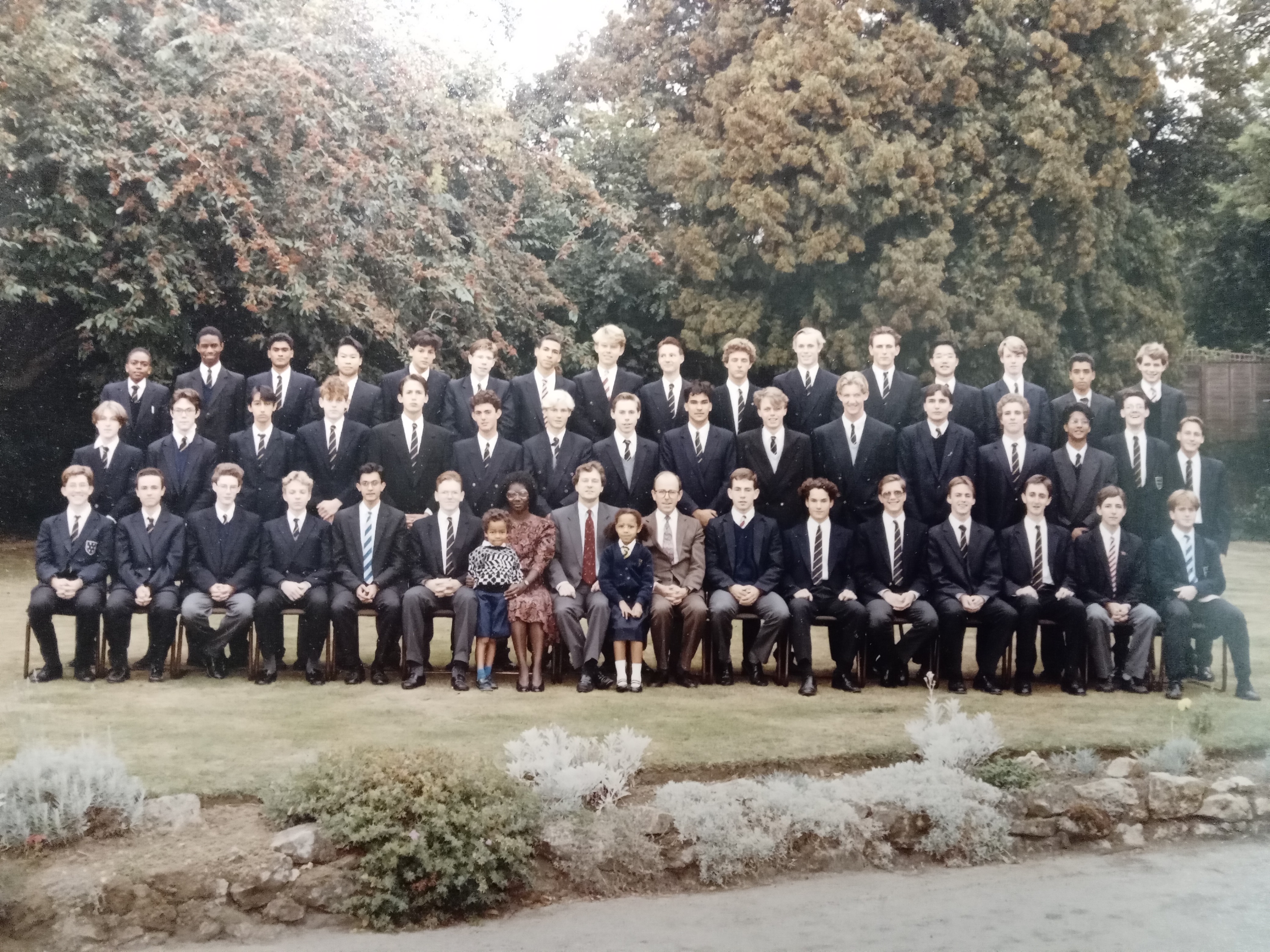
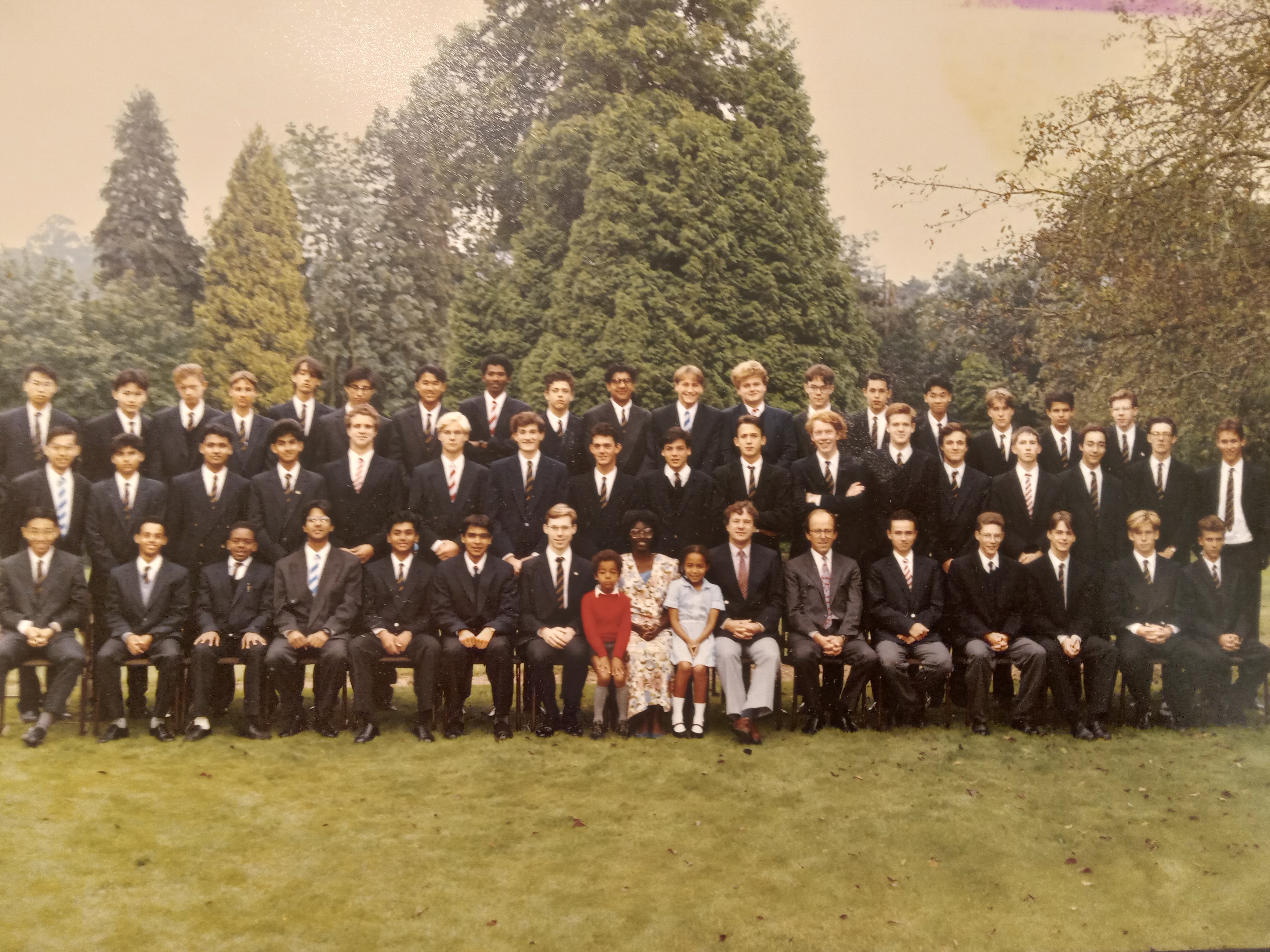
The International Centre, Sevenoaks School, in autumn 1990 (above) and autumn 1991 (below). In both photos Jim Scouse (in glasses) is in the front row, just to the right of the Winter family, and yours truly is in the middle row, second from the right end (wearing John Lennon-style specs).
I was sorry to hear last month that my old housemaster had died. That’s a very English sentence, and a very class-bound one. Anyone who’s been to an English boarding school will immediately know what I mean, but others may not have a clue what I am on about.
The housemaster was a man called Jim Scouse, and this is really a global story, not just about an English housemaster, who had a lot to teach me and others. It’s a story about globalism, and the part a particular brand of Englishness can play in it.
The house was the International Centre (IC), for sixth form boys, most of them from overseas, at Sevenoaks School in Kent. When I arrived at the IC as a 16-year-old in September 1990 it still had an unmistakable whiff of 1960s idealism about it. One of its early housemasters had been a man called Jonty Driver, a former president of the National Union of South African Students who had been detained without trial, in solitary confinement, for suspected involvement in the African Resistance Movement. I never met Driver, but felt that he still watched over us. In the early 1990s House photos, with a glamourous Driver and his wife, still lined its walls, 20 years after he had moved on. Driver was already a legend, and stories of him as a polymath, anti-Apartheid hero, poet and all-round good egg were still handed down.
It dawned on us that the IC was a special place: not just any old public school boarding house, but somewhere where independence of mind was valued. The house was ultimately run by its housemaster and tutor, of course, but much of the day-to-day discipline was overseen not by appointed prefects, but by a chairman and committee, elected by the boys every half term (I never made chairman, but I did serve as washing-up co-ordinator in my first term).
I was one of a few token Brits in an intake of 25 16-year-olds from all around the world. I certainly wasn’t there as a role model: in my late teens I was a bit of a wally (many would say I still am). This wasn’t the United Nations: more a cross-section of the global elite (the Sudanese guy in my year was the son of the general manager of Khartoum Airport), most of us doing the International Baccalaureate, and a few of us A-Levels, before going on to good universities in Britain, Europe or America. There were some other Brits, but unlike me most of them were the sons of expats who’d spent their childhoods abroad. There were some self-confident Germans and Dutchmen with names like Maximilian, Sebastian and Michael. But many of the others were slightly lost: boys from countries as far afield as Malaysia, Lesotho, Mexico, Canada, Kenya, Japan, Brazil, Egypt, Czechoslovakia, and Norway. They might have struggled to fit in at an English school which valued academic rigour, and in which few allowances were made for those who did not speak English as a first language (or in some cases, even as a second). That they thrived was in large part down to Jim Scouse.
Jim wasn’t technically the IC’s housemaster at all. In the early 1990s he was the house tutor – its number two, When we arrived the first guy we met was the housemaster, Peter Winter. Winter was well-qualified to run the IC, as a French teacher married to a Ghanian wife, with two young children. At first Winter seemed to be the friendly good cop, and Scouse seemed the grumpier bad cop (that old teachers’ adage, “Don’t smile till Christmas”, seemed to be Scouse’s watchword). But soon we all warmed to Scouse. Winter was in fact more aloof and less friendly the more you got to know him. He was an ambitious man, keen to become a headmaster (he eventually did so at a school in Bath, and then at Latymer in west London). He also had the misfortune to teach many of us. I had a run-in with Winter early on, when he over-reacted to my late arrival at a French class because of an overrunning music lesson, and I over-reacted by walking out (our relations only improved after the school chaplain mediated, and I dropped French as one of my main IB subjects).
Scouse, by contrast, was an English teacher who only taught A-Levels, so for most of us his pastoral role and academic roles were not confused. Unlike Winter, Scouse seemed to have no career ambitions, and to be happy with his lot.
****
Sevenoaks was (and no doubt still is) a good school. A good school in that it was academically rigorous, and wholesome. Not grand in the way that Eton, Marlborough or Oundle are. But good. The school’s buildings, on the eastern side of Sevenoaks’ High Street, were pretty ramshackle in the early 1990s (many have been spruced up or redeveloped since). One of them was supposedly designed by Lord Burlington, but the rest were buildings that would not look out of place at any state school. The IC itself was a shambolic 1880s house, with a 1960s extension, half a mile away. It had once been the Fawlty Towers-style Ormiston Hotel (nowadays the school’s marketing blurb describes it grandly as a “Victorian estate”). In the early 1990s Winter and his family lived in part of the functional 60s extension at one end of the IC. Scouse lived in a chaotic flat in a Victorian annex at the other end. It was a neat metaphor.
There was very little racism, and not much bullying, in the IC. For Scouse and Winter it must have been challenging, but fascinating, to deal with racism that was often completely unintentional (one boy, a black African, had to be gently spoken to after he jokingly referred to a boy of south Asian heritage using the P-word: there’d be no excuse for a white boy like me to have used it, but he was genuinely unaware that it was a taboo term). When I arrived at the IC Gulf War One was underway, and a few Middle Eastern boys from the year above had dropped out as war in Kuwait put paid to travelling to Britain. We were told by Scouse not to whoop with excitement at the latest news on CNN in the TV room, so as not to offend Muslim boys. A suicide attempt in my first year was dealt with sensitively by both Scouse and Winter. At the time we took all this for granted, but nowadays I can see it for what it was: good diplomacy.
Winter had just turned 40 when I arrived at the IC and Scouse was probably nearer 50, though his age, background, schooling and university days were unknown. He may have told us about them, but the memory has not stuck. He can’t have been poor, as he was on a good teacher’s salary and lived in tied accommodation (albeit in a flat that gave him little privacy, downstairs from a dormitory). He drove a beaten-up old VW campervan, in which he would often give a few boys a lift in the mornings, but he always had an air of mystery about him. Scouse was definitely not a scouser, but did he have a faint northern lilt? Or was it a West Country one? We never quite found out.
This was the early 1990s, and the Internet had not been properly invented: the nearest thing we had to it was MTV, Guns and Roses and Smells Like Teen Spirit. Attitudes to smoking and alcohol were very relaxed. A strange provision of the 1988 Children Act was that all boarding schools were required to give pupils a lockable drawer to which staff could have no access. These drawers became perfect places to store pornography, booze, tobacco and cannabis (I never came across other drugs). Smoking was openly tolerated at a “patch” in the house’s grounds (Winter once threatened to “close the patch down” during a disciplinary row, but never did).
The school may not like me saying this, but Scouse was very liberal with the booze. To mark birthdays he would invite groups of boys into his flat and serve both tobacco and alcohol, liberally (alongside soft drinks). But he’d precede these sessions by saying that while everyone could drink as much as they wanted, everyone would go to school tomorrow come what may. On time. We always did. It was one of the most important lessons any of us learned at Sevenoaks: how to hold our booze, and how to know when to stop.
In truth, Scouse was not an indulgent push-over. He set boundaries that were slightly different from those set by other teachers, but they were still unmistakable. “Do not defenestrate!” he would bellow at boys climbing out of ground floor windows. He only once gave me a serious bollocking. I’ve always been a heavy sleeper, and I was once slow to evacuate when someone burned the toast and the fire alarm went off early one Sunday morning. Scouse e summoned me into his flat for a dressing-down afterwards, and I smashed my head on the door frame as I skulked out afterwards. “Poetic justice from the lintel!” he shouted. I couldn’t disagree.
Oddly for an English housemaster, Scouse appeared to have no interest in sport, other than snooker (which he played with us regularly, and very well). Aside from pottering around in the house’s garden, the only physical exercise he seemed to ever take was walking his whippet dog. He once asked a group of us to name an activity that gave us perfect contentment, as a sort of icebreaking exercise. When it was his turn he said “swimming naked”. That certainly broke the ice, but nowadays few teachers would dare say something so open to misinterpretation.
Let me address the elephant in the room. Many accounts of twentieth-century British public schooldays are full of sadism, or worse, committed by masters. There was never any hint of that at Sevenoaks. If the school had ever seen abuse, it had been fully eradicated by the early 1990s. With hindsight it was an innocent interregnum, after the abolition of corporal punishment but before the paranoia about child abuse of the twenty-first century. Scouse was firmly unmarried. And looking back he had a slight resemblance to Kevin Spacey (who was, in those pre-The Usual Suspects days, largely unknown). A common homophobic trope is that a middle-aged bachelor must be gay. Another is that all gay man are sexual predators. There was some homophobic speculation about which boys might be gay in the IC, but none about Scouse. Our universal love for him meant that there was no vacuum to fill with speculation about his private life, and there was never any hint of inappropriate interest in boys. He sometimes led informal gardening work parties in the grounds, and on a few occasions a pretty brunette teacher joined them. Was she a girlfriend, Scouse was gently asked? He demurred. Show, don’t tell.
Many men like Scouse could have become pompous bores, presenting themselves as a model of 1990s English manhood. Don’t go to this university, go to that one. Read this book. Don’t read that one. Instead of all that, he just let us be ourselves. Although he was a great conversationalist, I remember remarkably little conversation with him. He listened more than he talked. I am sure Scouse had had a great time in the 1960s. But rather than tell us what an amazing guy he was, and give us loads of anecdotes about his life, he showed us how to be comfortable in our own skin.
In 1997 the IC moved to a purpose-built building, and the IC was occupied by School House (whose original building, supposedly designed by Lord Burlington, became classrooms). Scouse retired – and emigrated to Egypt if I remember rightly – and we lost touch. The school has just announced (in early 2025) that he had died in 2022, two or three years ago, so he sounds elusive right until the end.
Three decades on, I remember Jim Scouse not for what he said, but what he represented: tolerance, listening, not taking yourself too seriously. Show, don’t tell. He was always an enigma, and had a particular kind of undemonstrative Englishness that was the perfect foil to the more abrasive Winter. He was the perfect man to help run a boarding house full of 50 global teenagers – many of whom were (like me) awkward, lonely dropouts from other schools. As Robert Graves once wrote, “He was not a great man. He was better than that: he was a good one”.


 Alex Grant
nice piece Alex. He sounds a bit like Charlies housemaster who is very much still alive. Tricia
Alex Very interesting read – my brother was at Sevenoaks (albeit earlier than you) and I have shared it with him. Hope you are doing well. Keep writing! Pippa
Thanks – I did not know about your connection to Sevenoaks!
Very interesting to read.
I knew him from his previous role as an English teacher in Hampton School in the late 70s. I remember him as telling a lot of anecdotes and being a lot more ‘human’ than most of the other teachers, but curiously – looking back- I realise he gave very little about himself away.
It was the time of Punk (1977), in which a number of us were greatly interested, and I recall that instead of discouraging us, he encouraged us to write about it. One enterprising person – the late Paul Casimir, who must have been about 13 at that time- wrote about attending the first big Rock Against Racism event in 1978. HIs account was much praised by Jim and he effectively became his star pupil for a while.
Thanks Stuart – that is fascinating. Do tell us more about Jim Scouse’s time at Hampton School: I assume it was his workplace just before Sevenoaks (where he arrived in the early to mid 1980s, I think).