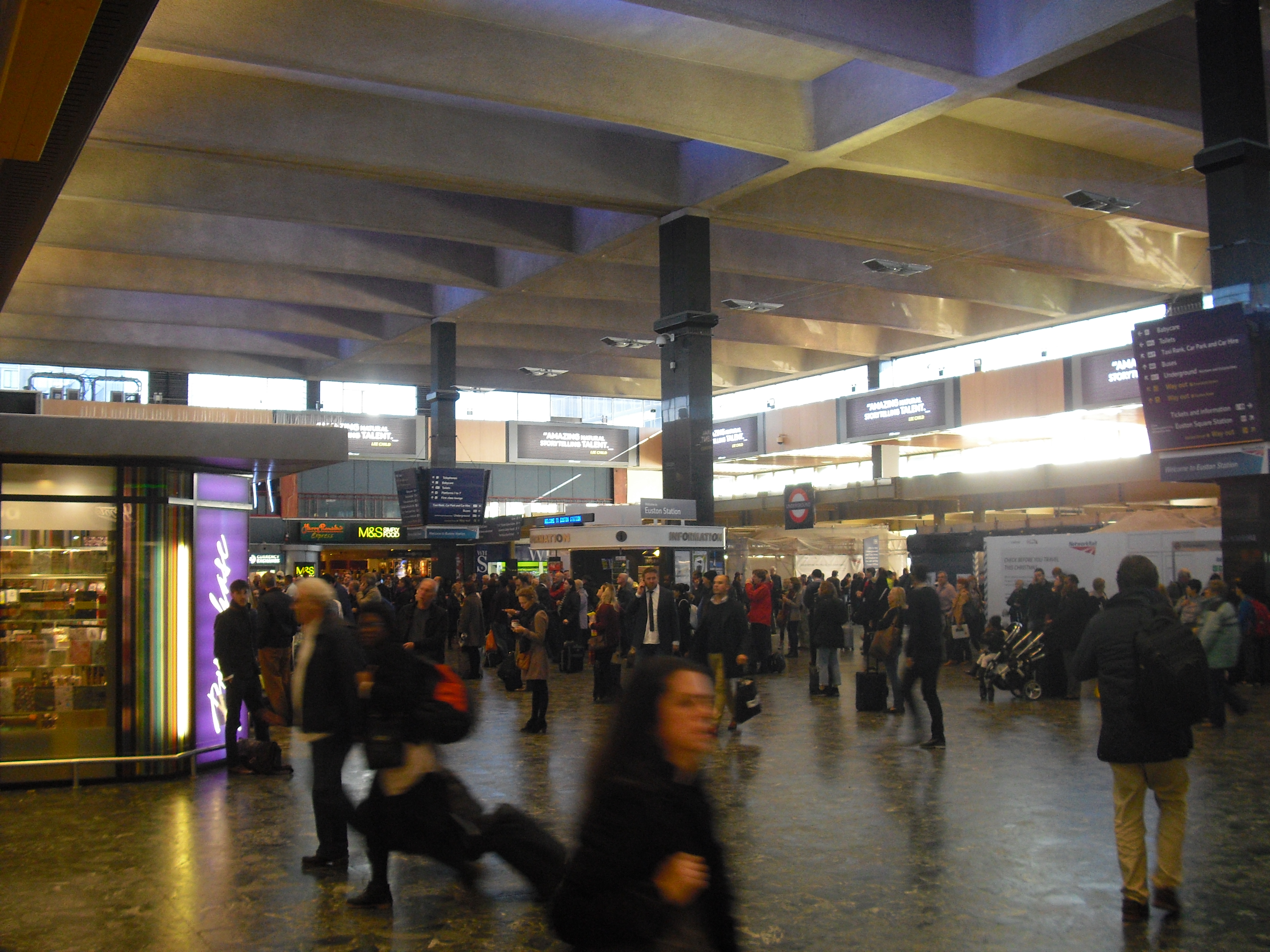
 A curious bidding war has been going on in London in the last few years: who can say the rudest thing about Euston Station. Last year, when it emerged that Euston’s 1960s building might be remodelled rather than demolished, Building Design columnist Ike Ijeh said that it was “relentlessly unlovable” and that “its coffin-like envelope, monolithic character, gloomy atmosphere and sterile public realm conspire to form an astonishingly dismal dystopia that seethes with architectural spite and aggression”.
Writing in The Times back in 2007, Richard Morrison thundered that “even by the bleak standards of Sixties architecture, Euston is one of the nastiest concrete boxes in London: devoid of any decorative merit; seemingly concocted to induce maximum angst among passengers; and a blight on surrounding streets. The design should never have left the drawing-board…. It gives the impression of having been scribbled on the back of a soiled paper bag by a thuggish android with a grudge against humanity and a vampiric loathing of sunlight”. I think that means he doesn’t like it.
The station has been variously described by others as “hideous”, “a dingy, grey, horizontal nothingness”, “an ugly desecration of a formerly impressive building”, a reflection of “the tawdry glamour of its time”, entirely lacking of “the sense of occasion, of adventure, that the great Victorian termini gave to the traveller”, and “the worst of the central London terminuses, both ugly and unfriendly to use”.
Local politicians agree. According to Sarah Hayward, Leader of Camden Council, Euston is “past its shelf-life” and “a barrier to effective regeneration of the immediate surrounding area”. Plans to refurbish the station rather than rebuild it are “ill conceived and poorly-planned” and “amount to a shed being bolted on to an existing lean-to”, offering “no regeneration or economic benefits”. Valerie Leach, the councillor in charge of regeneration in Camden until last May, has said that Euston is “a total nightmare” that “has to be completely redone.” The council’s Euston Area Plan says the station is “poorly designed and has a poor relationship with the surrounding streets and neighbourhoods”.
English Heritage, which recently rejected a bid from the Twentieth Century Society to list the station, has damned it with faint praise: although Euston is “a rare example of a major terminus of post-war date… not without merit, especially as regards the lofty main circulation hall”, its assessment added that “other important elements – notably the train shed – are disappointing”, the station’s plan “is seldom given any memorable architectural expression,” and “its lucidity is compromised by later interventions”. In architect-speak “disappointing” is often code for “worthless”: Euston may indeed be a rare survival, but from a period in architectural – and railway – history that many would rather forget. Continue reading →








 Alex Grant