
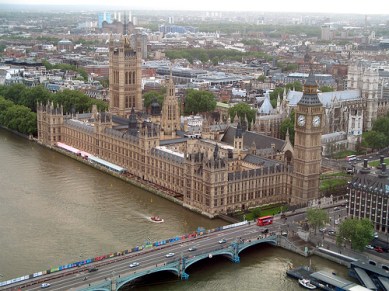
 News that the Palace of Westminster will be out of bounds for six years for the £4bn mother of all restorations has provoked a stream of predictable responses. A strange coalition of metropolitan Guardianistas like John Harris, nationalists and devolutionists are angry that Parliament won’t be moving to a new building outside London, either permanently or temporarily. Traditionalists have welcomed the news that Parliament should move back to a restored palace in 2029, six years after the restoration begins in 2023. But just about everyone has questioned the logistics of decanting the Lords to the QE2 conference centre, and the Commons to the Department of Health building off Whitehall, in between times.
Oddly, hostility to the palace has focussed as much on its supposedly elitist Gothic style as on its London location. Few have stopped to think about the building’s form, size and shape – its bones – rather than its superficial architectural style.
****
I worked part-time in Westminster as an MP’s researcher from 2008 to 2012. I am known to love Victorian architecture and was often asked by friends how much I loved working there. The answer was not that much: although I worked for an MP (Nick Raynsford) I admired, and alongside some great colleagues, I found Parliament a difficult place to work in. Continue reading

 One Saturday morning a few weeks before the referendum there were two Vote Leave stalls on the streets of Thrapston, the Northamptonshire market town a few miles from my home. I was in a hurry, buying eggs and vegetables at the market, and in no mood for a political discussion when I was approached by a friendly-looking, 60-something man in a red Vote Leave T-shirt. I had to think on my feet to politely decline the leaflet he offered. “No thanks, I’m a Labour voter,” I told him foolishly. “So am I,” he replied.
 The spectacular collapse of Boris Johnson’s Prime Ministerial hopes earlier today have a striking historical parallel. Boris is not – and never has been – the Donald Trump or Winston Churchill of contemporary British politics, or even the Falstaff or Dennis the Menace. Johnson’s career, and its apparent demise, now bear an uncanny resemblance to a half-forgotten giant of Conservative politics: Quintin Hogg, Viscount Hailsham (1907-2001).
 or two months in the run-up to Christmas 2015 I worked the night shift at a Royal Mail sorting office in Peterborough. Media commentators are often quick to appoint themselves as experts on the labour market, but most have never stepped inside – let alone been employed in – places where Brits work alongside Eastern European migrants. I have, and the experience made me even more determined to vote Remain in the EU referendum today.


 Alex Grant